Key Takeaways
- Social trading could produce crypto’s next Roaring Kitty.
- Public traders and online groups could accumulate substantial influence.
- AI agents may eventually compete beside people on trading leaderboards.
Seven Predictions Show How Social Trading Could Reshape Crypto
Social trading applications increasingly combine market data, public performance records, discussions, and trade execution within unified interfaces. Ryan Watkins, co-founder of crypto-focused hedge fund Syncracy Capital, placed that trend at the center of seven predictions shared in an Aug. 31 post on X.
The forecasts envision a solo trader displaying nine-figure results, profit-and-loss leaders gaining celebrity followings, and online groups controlling more capital than institutional crypto funds. The co-founder also predicted:
“The top social finance creators will make money from rewards that rivals top social media influencers.”
Watkins had outlined related ideas in an Aug. 27 essay. He estimated that onchain trading products account for less than 0.5% of global daily active traders, leaving substantial room for consumer adoption.
Public blockchain records allow applications to display trading histories and positions in real time. He expects platforms to combine that information with social activity and personalized recommendations. He also predicts that autonomous agents will compete with people on leaderboards while trading increasingly resembles sports and a massively multiplayer online role-playing game (MMORPG).
Fomo and Pump Gain Ground Among Crypto Trading Apps
Fomo is a social-first crypto trading application, while Pump is Pump.fun’s mobile application for launching and trading Solana memecoins. Watkins compared them with Polymarket, an event-contract market; Hyperliquid, an onchain perpetuals exchange and blockchain; and Phantom, a self-custodial wallet and trading application.
His essay states:
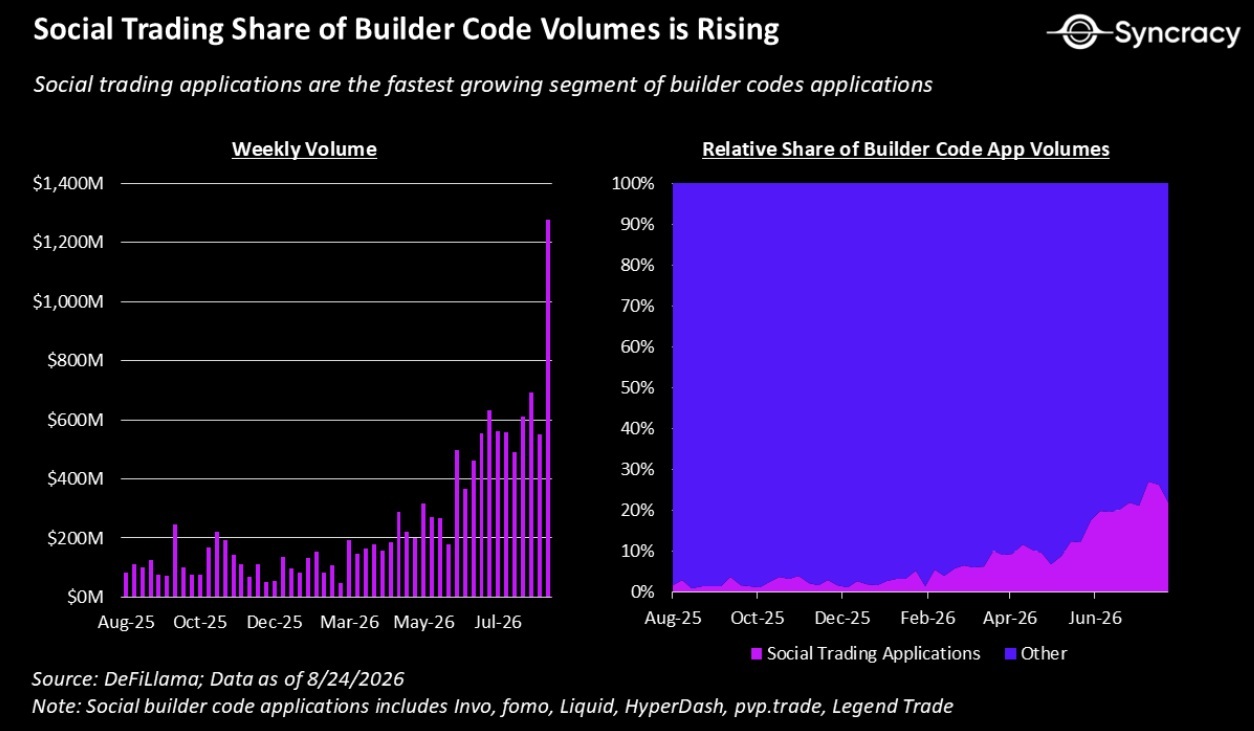
“Already today Fomo and Pump have reached similar daily active user counts as Polymarket, Hyperliquid, and Phantom, which possess ~60K – 100K each. Social trading applications are also the fastest growing segment of builder code interfaces on Hyperliquid, accounting for ~33% of all builder code volume.”
Builder-code interfaces are third-party applications that route orders through Hyperliquid, while builder-code volume measures the trades they generate. Crypto exchange OKX has also moved into the sector through Orbit, its social trading platform, which combines group discussions, livestreams, and verified performance data.
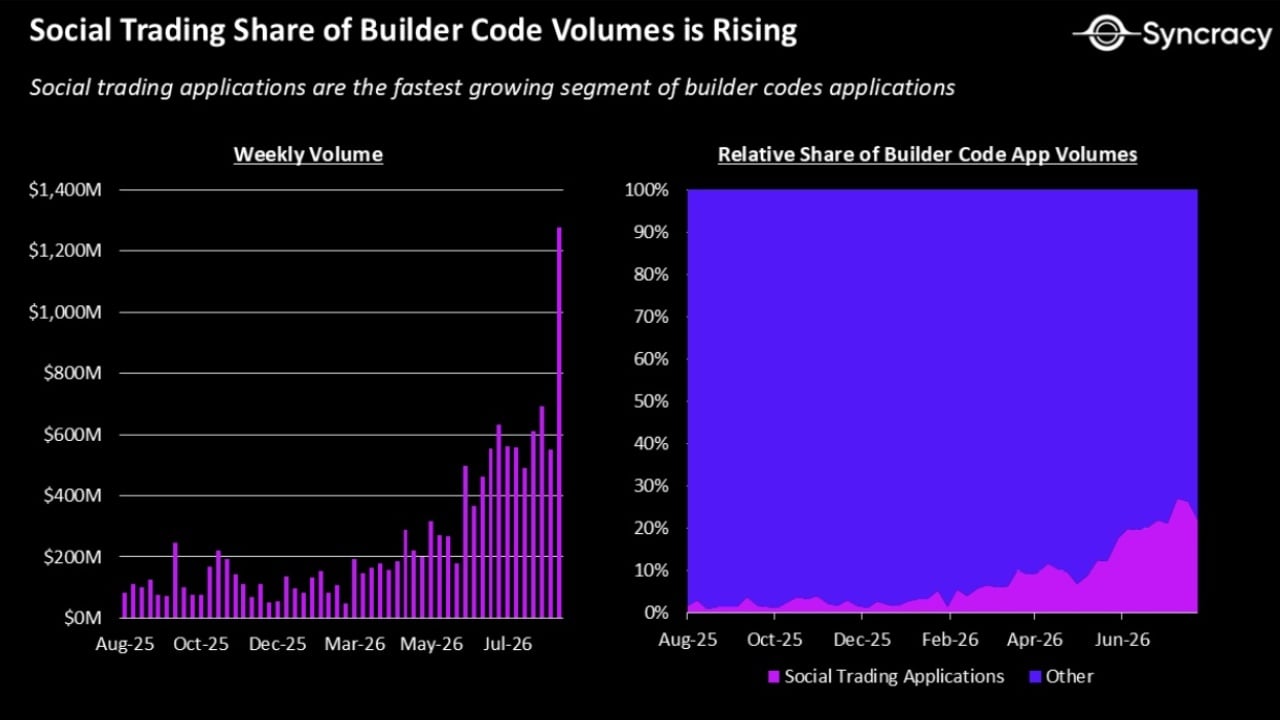
Syncracy’s chart, based on Defillama data through Aug. 24, shows weekly volume from social trading applications approaching $1.3 billion.
Creator rewards provide another growth mechanism. Pump.fun has experimented with fee structures for token creators, although it later moved to rebalance creator and trader incentives after finding that its earlier system favored launches over trading participation.
Social Apps Could Drive Volume to Onchain Markets
Watkins described social trading applications as a connection between consumer activity and crypto market infrastructure:
“Social trading applications in effect are serving as their fastest-growing and most highly incentivized distribution channels.”
Many social trading applications offer perpetual futures on decentralized exchanges, allowing users to take leveraged positions without an expiration date. Collateral backs each position, funding rates help align contract prices with spot markets, and automated liquidations close positions that fall below maintenance requirements.
He reported that Pump had paid more than $450 million in rewards to token deployers. He also estimated that users often pay 2% to 3% per memecoin swap, or 20 to 30 times the cost of trading major assets on spot exchanges.
His broader argument is that speculation previously helped establish stablecoins, prediction markets, and perpetual swaps before those products gained wider uses. Watkins expects social applications to deliver similar benefits to the blockchains and exchanges processing their trades:
“So regardless who wins and what the end market structure looks like for these applications, what we can say with confidence is that they will drive enormous volumes to the underlying rails over the coming years.”
Next Roaring Kitty Could Emerge Through a Trading App
Keith Gill, known online as Roaring Kitty, helped build retail interest in Gamestop through social media posts and a publicly discussed investment thesis. His May 2024 return contributed to renewed volatility in meme stocks and crypto tokens.
Watkins predicted:
“The next Roaring Kitty/Gamestop-esque movement will emerge on a social trading app.”
Combining communication, public performance records, and trade execution could accelerate such a movement. Users could follow a trader, discuss an idea, and copy a position without moving between separate platforms.
The structure also carries manipulation risks. A February investor alert from the Securities and Exchange Commission (SEC) warned that social media recommendations can support pump-and-dump schemes, undisclosed promotions, scalping, and impersonation.
Memecoins also have thin liquidity that may limit copy trading at scale. The unresolved question is whether speculation-focused applications can move users toward tokenized securities, stablecoin savings, and other financial services without losing the audiences that fueled their growth.
