
Key Takeaways
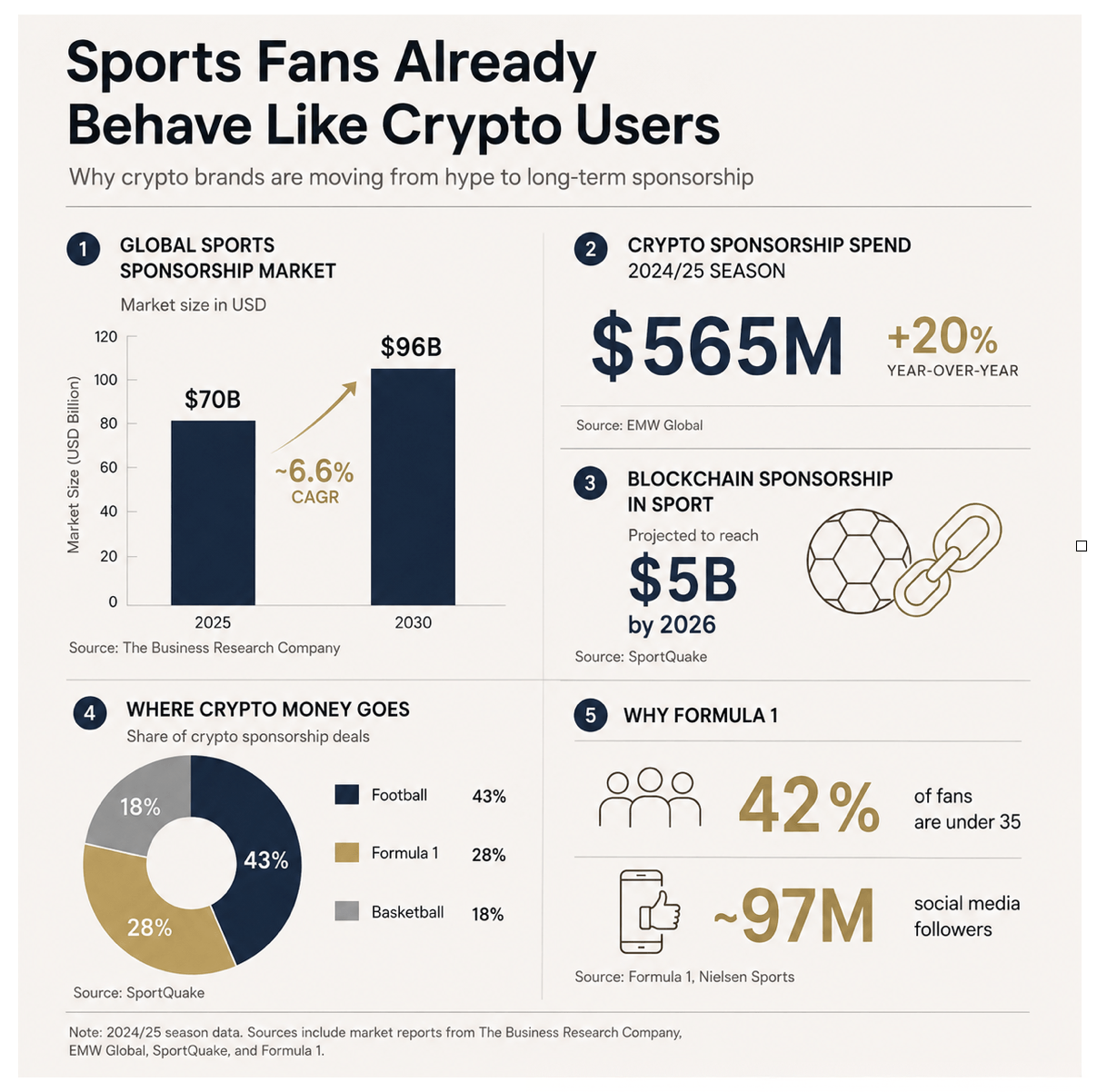
- Crypto sports sponsorship spending climbed 20% to $565M in the 2024/25 season.
- Formula 1 drew 28% of crypto sponsorships, backed by 97M social media followers.
- Football captured 43% of crypto sports spending as brands shifted toward long-term fan engagement.
The following opinion editorial is a guest post written by Alex Kozenko, WhiteBIT‘s chief marketing officer, who leads the cryptocurrency exchange’s global marketing strategy and international sports partnership initiatives.
At the same time, hundreds of millions of people were sitting in stadiums who already knew how to do everything we needed from them: stay loyal for years, pay for a club scarf just because it has the badge on it, and follow the starting lineup as if it were a matter of life and death.
This is basically the whole secret of why sport has become not just an image line in crypto marketing budgets, but a real channel for entering the mass market. Below, I will explain why it works, what it means in numbers, and where the people behind such deals usually make the same mistake.
A Fan Is a Ready-Made Product, Just With Someone Else’s Label
Marketers spend years trying to build audience loyalty. A sports fan already has it – at an industrial scale, and completely free for us. You do not need to explain to them what brand attachment is. They have lived with it since childhood.
This is why sports audiences are so interesting for brands in general, and for crypto in particular. The scale of this interest is easy to check by looking at the money going into it: analysts at The Business Research Company estimate the global sports sponsorship market at around $70 billion in 2025, with expected growth to $96 billion by 2030 at an average annual growth rate of about 6.6%.
For me, this number is not just about the size of the market. It shows the collective choice of thousands of companies that could have invested this money anywhere, but chose sport as one of the most reliable ways to buy not just attention, but trust. And trust, as we all know, has been in short supply for crypto in recent years.
What Is Happening With Crypto in Sports Partnerships
I separately follow the dynamics of the crypto segment, and it tells a story of maturity, not hype. According to an EMW Global report, in the 2024/25 season crypto brands increased their sports sponsorship spending by 20% year over year, reaching $565 million. The overall blockchain sponsorship market in sport, according to the same estimates, is expected to reach $5 billion by 2026.
I read this in the following way: the industry that was cutting sports budgets a few years ago has not only returned, but returned with a more sober approach. Earlier, crypto entered the sport for hype. Now it enters through long-term contracts. These are two completely different models of behavior.
The distribution of budgets inside crypto is even more interesting.
Football takes 43% of this money, Formula 1 takes 28%, and basketball takes 18%, according to SportQuake. The choice of Formula 1 is not about prestige, but about demographics: 42% of its fans are under 35, and its total social media audience is close to 97 million followers.
In other words, crypto brands pay for F1 not because of the size of the room, but because the right audience is sitting in that room – the people who are easier to introduce to concepts like wallets and swaps. Football wins in a different way: through deeper and more repeated contact during the whole season, not just during separate race weekends.
A Logo No Longer Works on Its Own
This is where I come to the observation that I consider the most important in this whole analysis. Logo placement by itself no longer creates the same value it used to. Sponsors are paying less and less just to be seen, and more and more for the audience to actually do something with them: click, download, get a card, or take part in an activation.
In practice, I see two working formats, and they solve different tasks rather than competing with each other.
The first is classic presence through a strong advertising asset that lives in every replay and every broadcast. At WhiteBIT, we chose this format when we became the sleeve partner of Juventus. The partnership includes joint digital content, exclusive activations, and initiatives for fans of both the men’s and women’s teams.
The logic is the same as with Barcelona: first, we get attention through a visible asset, and then we turn that attention into interaction. Attention without interaction disappears quickly. This is one of the main mistakes I try to avoid in our campaigns.
The second format goes beyond visibility and turns the partnership into a product that the fan actually uses. A good example is long-term agreements between crypto companies and major football clubs that go beyond simple advertising and include joint digital products and services for fans.
I do not want to present these two examples as a “bad” and a “good” approach. That would not be fair. Both solve their own task: the sleeve maximizes reach here and now, while product integration builds retention for years ahead. A good sports strategy almost always combines both layers.
First, you capture attention through a strong visible asset. Then, you convert it into something the person can take with them. If this second part is missing, the partnership turns into expensive outdoor advertising that looks good in a report but leaves nothing after the final whistle.
Why Deals Like These Are So Rare
There is one thing that people sometimes avoid saying out loud: deals like this cannot simply be bought by having a bigger budget than your competitor. Clubs of this level choose who they stand next to very carefully because they are risking their own century-old reputation.
This also explains why there are not many partnerships like this. The sponsorship market in top sports is becoming more saturated, the number of exclusive positions at leading clubs is limited, and competition for them is getting stronger every year.
That is why sport remains one of the shortest paths to the mass user. The fan comes to us already prepared: with loyalty, a habit of paying, and a digital environment that would take years to build in almost any other audience.
I do not look at a full stadium as a crowd of spectators. I look at it as an audience that already knows everything the rest of the market has been trying to teach people from scratch for years.
The question is not how to convince these people to trust a new technology but whether we are ready to speak to them in the language of what they already love, or whether we will start explaining blockchain from zero again.
