Disclaimer: This article is for informational purposes only and does not constitute financial advice. BitPinas has no commercial relationship with any mentioned entity unless otherwise stated.
📬 Get the biggest crypto stories in the Philippines and Southeast Asia every week — subscribe to the BitPinas Newsletter.
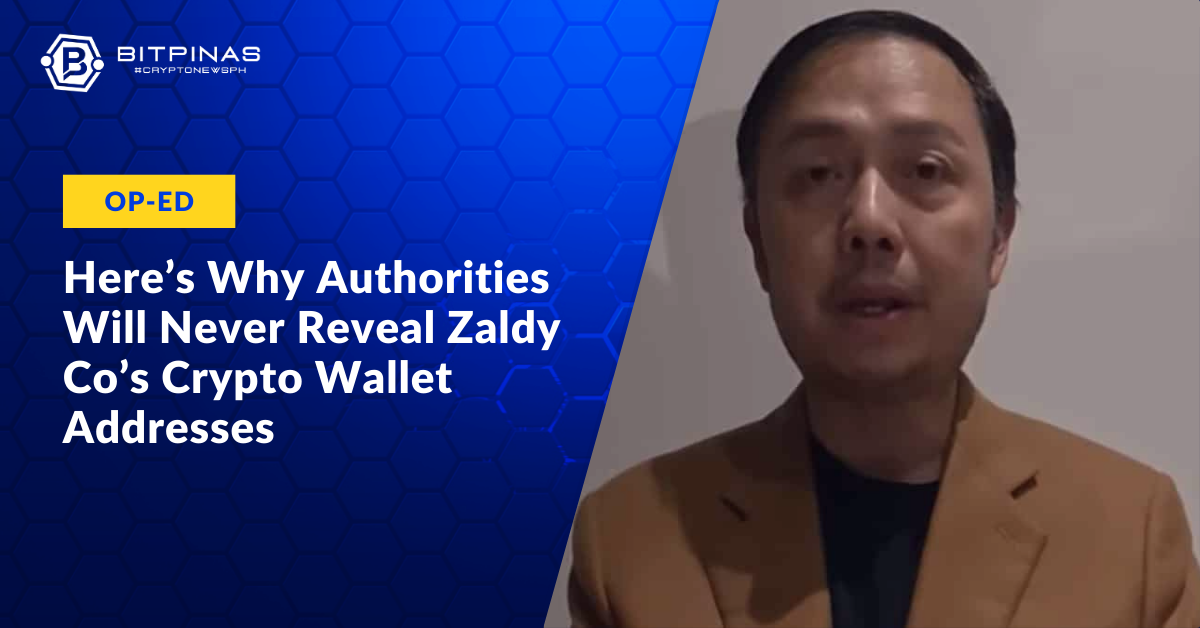
Following the revelation by DILG Secretary Jonvic Remulla that former lawmaker Zaldy Co allegedly moved ₱5 billion out of the country using cryptocurrency, a critical question has emerged from the public: Where are the wallet addresses?
A similar claim has been made by Undersecretary Renato Paraiso, who earlier said in TV interviews that several flood control personalities have laundered funds into crypto.
While the government has provided a (somewhat) specific figure, they have not notably released the transaction hashes or wallet addresses that would verify the claim on the public blockchain.
However, based on the timeline of the recent Anson Que kidnapping case, this silence appears to be a calculated strategic move rather than a lack of evidence.
The Anson Que Precedent: A Timeline of Strategic Silence

The government’s handling of the Anson Que case, where a ₱200 million ransom was laundered through crypto, might give as an idea of the blueprint for how Philippine authorities handle high-profile crypto investigations.
Phase 1: The Silence

When news first broke that businessman Anson Que had been kidnapped (and killed) and a ransom was paid in cryptocurrency, the Philippine National Police (PNP) and Anti-Kidnapping Group (AKG) did not immediately release the wallet addresses to the media. Public reports only confirmed that crypto was used.
In fact, our headline reads: PNP Seeks AMLC Help to Trace ₱200M Crypto Ransom in Anson Que Kidnap-Murder Case
Phase 2: The ‘Blurred’ Reveal

Weeks later, during a press conference, authorities finally presented the blockchain trail. However, even then, specific wallet addresses were often blurred or partially redacted in presentation slides. It was revealed that the funds were funneled through casino junket operators (9 Dynasty and White Horse) before being converted into USDT. (Read more: PNP Subpoenas Local VASPs, ₱4.5M in Crypto Frozen by Foreign Exchange in Anson Que Ransom Case)
Phase 3: The Full Picture
It was only after the investigation concluded that the full extent of international cooperation was revealed. Reports later confirmed that the PNP had been working secretly with Chainalysis, Tether, and Binance to track the funds.
Behind the Scenes: Chainalysis, Tether, and Binance

The reason for the initial silence in the Que case was possibly to allow “backend” cooperation to take place without alerting the suspects.
- Chainalysis: The blockchain analytics firm worked with the PNP using its “Reactor” tool to map the flow of ransom payments through a web of intermediary wallets.
- Tether: Because the ransom was converted to USDT (a stablecoin), it led to a collaboration with Tether (the USDT issuer) which then led to the successful freezing of approximately $79,800 (₱4.5 million) worth of USDT held in the suspects’ wallets.
- Binance: The exchange’s Financial Intelligence Unit also assisted, helping trace $3.75 million in crypto ransom tied to the junket operators.
Had the government released the wallet addresses immediately in Phase 1, the suspects would have been alerted and could have moved the funds to mixers or privacy coins, making recovery more challenging.
Why Silence is Necessary: The ‘Snake’ Analogy
During the Anson Que investigation, PNP Chief Gen. Rommel Marbil explained the difficulty of freezing crypto assets if the information is leaked too early.
“It’s like a snake, if you freeze it now, it gets to move somewhere else the next moment,” Marbil stated.
By keeping the addresses private, authorities can petition offshore exchanges and stablecoin issuers (like Tether) to blacklist the specific addresses, effectively rendering the stolen funds useless.
What This Means for the Zaldy Co Case
Applying this precedent to the Zaldy Co investigation, it is highly probable that authorities are currently in the “backend” phase of the operation.
While Secretary Remulla has publicly announced the ₱5 billion figure to apply political pressure, the non-release of wallet addresses suggests that authorities are likely:
- Tracing the funds through forensic tools like Chainalysis Reactor.
- Coordinating with stablecoin issuers or major exchanges to freeze the assets.
- Avoiding a public “doxxing” of the wallets that would prompt Co to “mix” or move the funds further.
If the Anson Que timeline is any indication, the public can expect a detailed breakdown of the blockchain trail only after the assets have been successfully frozen or the investigation has reached a point where secrecy is no longer a tactical advantage.
And even then, the full addresses would never be revealed.
This article is published on BitPinas: Why the Gov’t Won’t Release Zaldy Co’s Crypto Addresses: The Anson Que Precedent
What else is happening in Crypto Philippines and beyond?
