
Hedera operates as an enterprise-grade public network designed for the decentralized economy. Developers and organizations rely on this platform to build fast, secure, and scalable applications. Known for its distinct Hashgraph consensus algorithm, Hedera offers a radical departure from traditional blockchain architecture. This guide explores the current market performance of Hedera, reviews its historical milestones, and unpacks the technological framework driving the HBAR token.
HBAR Price Today
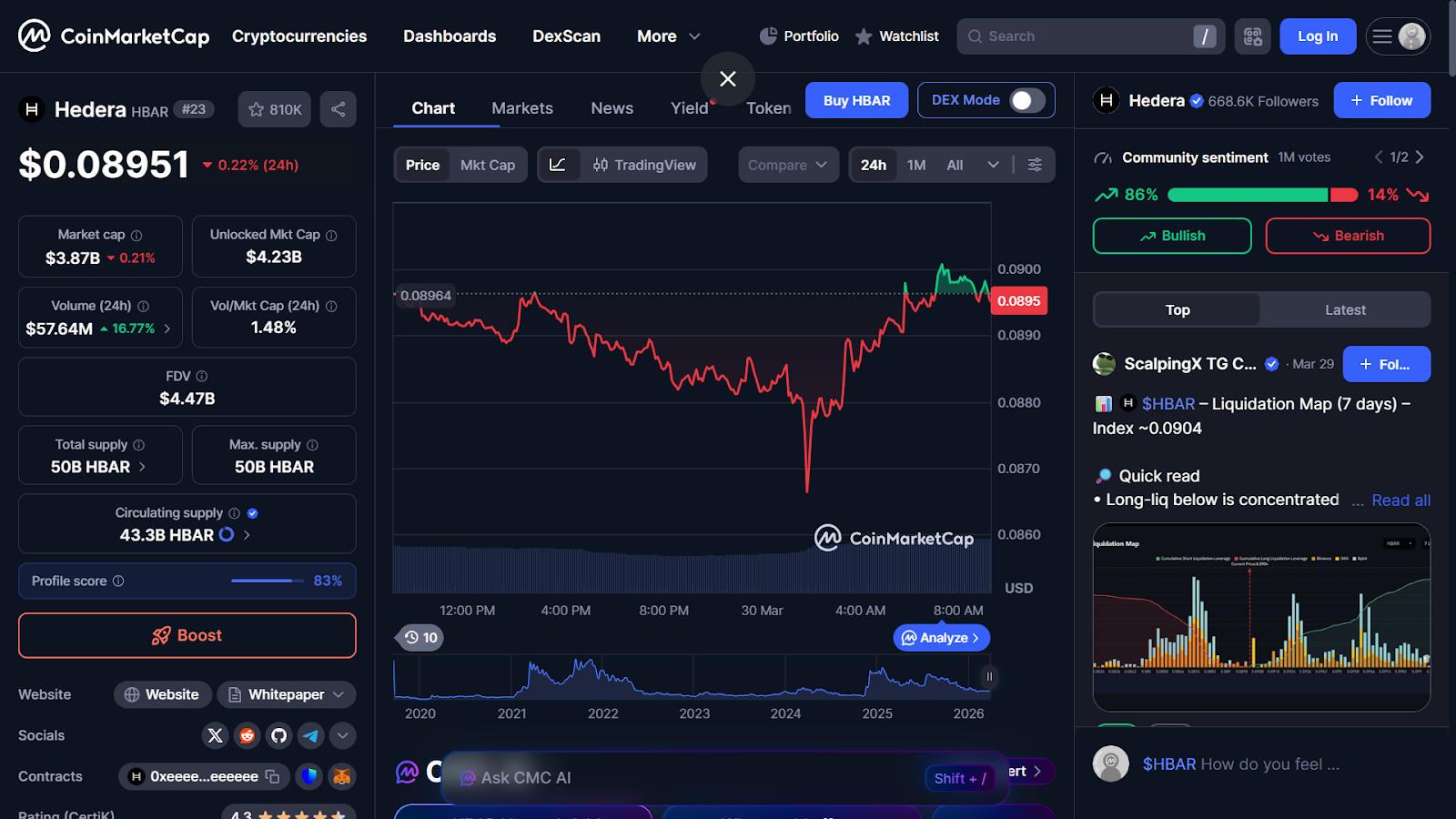
The current price of hbar today on Hedera is currently priced at $0.08951, experiencing 16.77% shift within the past 24 hours. With a market capitalization of $3.87 billion and an unlocked market cap of $4.16 billion, Hedera remains a significant player among top digital assets. The 24-hour trading volume of $41.14 million demonstrates healthy market liquidity, and the volume-to-market cap ratio stands at 1.48%. The fully diluted valuation, if all 50B HBAR were in circulation, is $4.4 billion.
Presently, 43.3 billion HBAR are circulating, with the remaining gradually released from the Hedera Treasury based on network milestones and ecosystem growth initiatives. While daily price dips reflect overall crypto sector movements, HBAR’s strong adoption rate and technology roadmap continue to attract both retail and institutional interest.
HBAR Price History
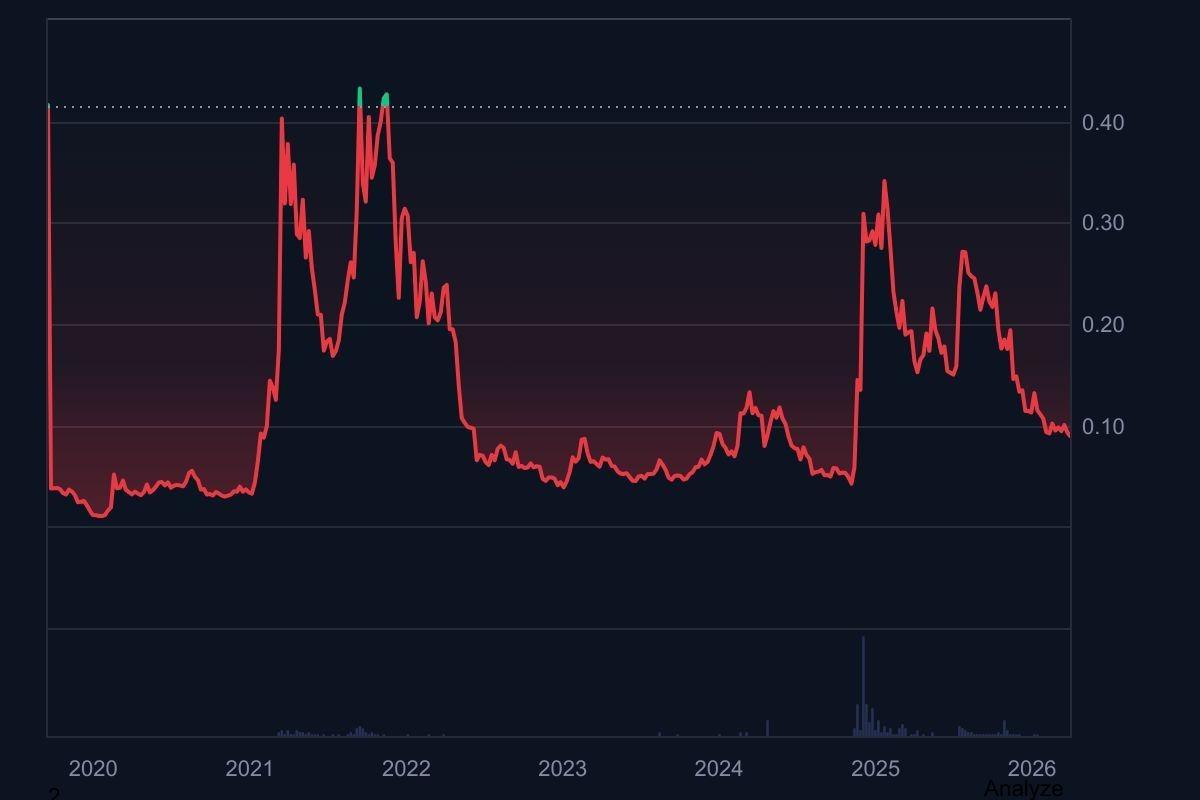
Hedera has navigated multiple market cycles since its inception. Hedera price history provides valuable context for its current market position. Below is a summary of key historical milestones:
| Metric | Price | Date | Difference from Current Price |
| All-Time High | $0.57 | September 16, 2021 | -84.5% |
| All-Time Low | $0.01 | January 2, 2020 | +781.00% |
HBAR’s all-time high of $0.57 occurred in 2021 during a surge in blockchain interest and news of high-profile enterprise partners joining the Hedera council. Since then, market swings and global economic pressure have brought the price lower, though today’s value remains significantly higher than at launch. HBAR’s all-time low, near $0.01 at launch, highlighted the speculative risk and rapid initial adoption curve experienced in the early days.
Hedera’s steady history of mainnet upgrades, new DeFi and NFT projects, and a growing list of enterprise dApps has helped price resilience even as recent years have seen more gradual, utility-driven growth.
What Is Hedera (HBAR)?
Hedera functions as a fully open-source public distributed ledger. The Hedera public network gives developers the tools to build secure applications with high throughput. The HBAR cryptocurrency powers this ecosystem by funding transaction fees and protecting the network against malicious actors through proof-of-stake mechanisms. Hedera aims to solve the critical limitations of traditional blockchains. These include speed, cost, and scalability.
What makes Hedera Hashgraph unique?
Most cryptocurrency networks bundle transactions into sequential blocks. Hedera takes a different approach by utilizing a directed acyclic graph structure known as Hashgraph. Nodes within the network communicate constantly using a protocol called gossip about gossip. Every node shares information about transactions with other randomly selected nodes. This rapid data sharing creates a timestamped history of network activity.
The network combines this gossip protocol with virtual voting to achieve finality in seconds. This structure eliminates the need for energy-intensive mining. Consequently, Hedera operates with a near-zero carbon footprint while maintaining enterprise-grade security. Hedera achieves fairness by timestamping all events, so the sequence of recorded data is clear, secure, and tamper-proof.
The governance model also sets Hedera apart. The Hedera Governing Council manages the network. Up to 39 diverse, term-limited global organizations make up this council. They guide software decisions, manage treasury allocations, and operate the initial validator nodes. This corporate oversight provides a level of stability and regulatory compliance that appeals heavily to institutional users.
What can you use Hedera for?
Organizations deploy applications on Hedera across multiple industries. The primary use cases include:
- Supply Chain Management: Companies track products from manufacturing facilities directly to consumers. The network provides verifiable authenticity and transparent provenance for goods.
- Decentralized Finance: Developers build lending protocols, decentralized exchanges, and automated market makers, taking advantage of the low transaction fees.
- Decentralized Identity: Institutions create secure, self-sovereign identity solutions that protect user privacy while meeting compliance standards.
- Micropayments: Content creators and media platforms use the network to process fractional payments without losing revenue to intermediary processing fees.
- Verifiable Credentials: Healthcare providers and educational institutions issue digital credentials that anyone can instantly verify on the public ledger.
The predictable fee structure plays a massive role in this adoption. Transaction costs remain pegged to the US dollar, meaning developers can forecast their operational expenses accurately regardless of HBAR price fluctuations.
Who are the founders of Hedera Hashgraph?
Dr. Leemon Baird and Mance Harmon founded the Hedera network. Dr. Baird holds a Ph.D. in computer science and invented the core Hashgraph distributed consensus algorithm. He serves as the Chief Scientist of Swirlds Labs, the company driving development on the network.
Mance Harmon serves as the CEO of Swirlds Labs. He brings extensive experience as a technology executive, having previously managed massive software programs for defense and cybersecurity organizations. Together, Baird and Harmon built the foundational technology and established the governing council structure to foster long-term network growth.
HBAR Tokenomics and Supply
The HBAR token serves two critical functions. It acts as network fuel to pay for application transactions, and it secures the network through staking. Below is a breakdown of the tokenomics:
| Category | Quantity | Purpose |
| Circulating Supply | 43.3 billion HBAR | Available for trading and staking |
| Total Supply | 50 billion HBAR | All coins that will ever exist (hard cap) |
| Maximum Supply | 50 billion HBAR | No inflation, guaranteeing long-term scarcity |
| Market Cap | $3.81 billion | Total value of circulated tokens |
| Unlocked Market Cap | $4.16 billion | Reflects tokens released from the treasury |
| FDV | $4.4 billion | Theoretical value at total supply |
The total max supply of HBAR is permanently capped at 50 billion coins. The Hedera Treasury manages the gradual release of these Hedera token services to fund ecosystem grants, compensate node operators, and support core development.
Network users can stake their HBAR to a validator node. Staking helps secure the ledger and rewards participants with a percentage yield. Because the transaction fees are paid in HBAR, increased network usage naturally drives demand for the token.
Where to buy HBAR today
Retail investors and institutions can easily acquire HBAR across major cryptocurrency exchanges. Platforms like Binance, Coinbase, Kraken, and KuCoin offer direct trading pairs for the token.
Users must create an account and complete standard identity verification protocols. After linking a payment method, buyers can execute their trades. Security experts highly recommend transferring purchased tokens to a personal hardware wallet to maintain full custody of the digital assets
Hedera’s Latest Developments in 2026
The Hedera ecosystem introduced several massive upgrades in 2026 to capture a larger share of the enterprise market. The governing council approved and implemented new cross-chain interoperability standards. These protocols allow decentralized applications to move digital assets seamlessly between Hedera and other major networks like Ethereum and Solana.
Swirlds Labs also deployed advanced smart contract privacy tools. Financial institutions can now process sensitive customer data on the public ledger while meeting strict regional data protection laws. This upgrade triggered a wave of adoption from traditional banking entities looking to tokenize real-world assets.
Network performance reached new heights as well. Hedera consistently processed over 15,000 transactions per second throughout the year. This volume stemmed directly from commercial applications rather than speculative trading, highlighting the practical utility of the Hashgraph consensus algorithm.
FAQs
HBAR is currently valued at $0.088415. Prices change rapidly, so check trusted sites like CoinMarketCap for the most current figures.
The current market capitalization stands at $3.81 billion, calculated by multiplying the price by the volume of coins in public circulation.
Hedera is one of the more established enterprise-led networks, but crypto remains risky. Diversify investments and do your own research before buying.
There are no guarantees in this market. Achieving $1 would require major network adoption, strong market conditions, and ongoing developer support. Growth potential exists, but the timeline remains uncertain.
