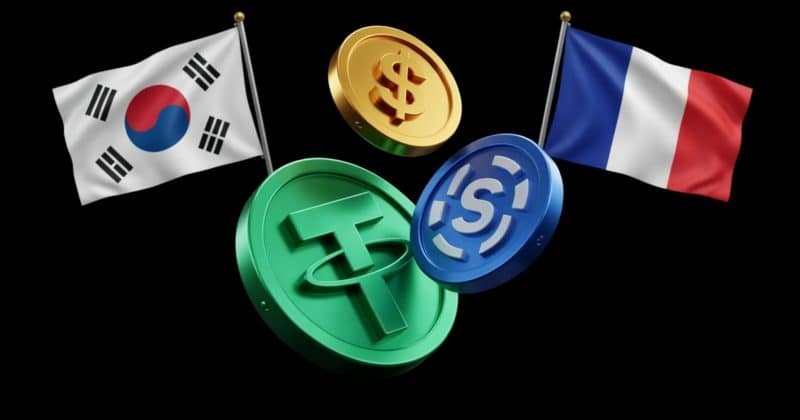
The Bank of Korea and Bank of France are hosting a two-day seminar on digital assets and climate change to explore their effects on the economy and central bank roles, according to Yonhap, South Korea’s main national news.
The forum will conclude on Wednesday, bringing together central bank researchers and academic experts from both countries.
Participants discussed central bank digital currencies, payment systems, macroeconomic risks, and financial policy challenges as part of an ongoing academic exchange program alternating between the two countries.
The seminar is the latest in a recurring academic exchange program that the two countries started in 2024.
“The two institutions will exchange views on the role of central banks and policy response directions amid recent changes in the financial environment,” the Bank of Korea said in a statement.
Stablecoin growth and regulatory responses
Stablecoins worldwide have grown to an estimated $311 billion in market value, compared with about $50 billion half a decade ago.
Transaction volumes processed through stablecoins surpassed $34 trillion in 2025, a figure that shows how quickly these instruments have become part of cross-border commerce and institutional settlement.
South Korea’s central bank requires won-pegged stablecoins to be issued only by licensed banks to safeguard monetary policy and prevent rapid USD outflows, with legislation expected by mid-2026.
Meanwhile, in France, digital assets are classified as negotiable intangible property, placing stablecoin issuers under ACPR oversight, and all issuers must be fully licensed under the EU MiCA framework by June 30, 2026.
The passage of the GENIUS Act in mid-2025 established the first comprehensive federal framework governing stablecoin issuance and reserves in the US.
The legislation triggered a wave of similar regulatory initiatives across multiple jurisdictions, accelerating a global push toward standardized rules for digital asset oversight.
