Key Takeaways
- Layertree proposes letting millions share one Bitcoin output without surrendering control of their bitcoin.
- Layertree models 1,020 vB individual withdrawals and group enrollment below 1 vB per member.
- Bitcoin needs protocol changes before Layertree can operate, and simultaneous withdrawals remain a challenge.
One Bitcoin Output, Millions of Individual Owners
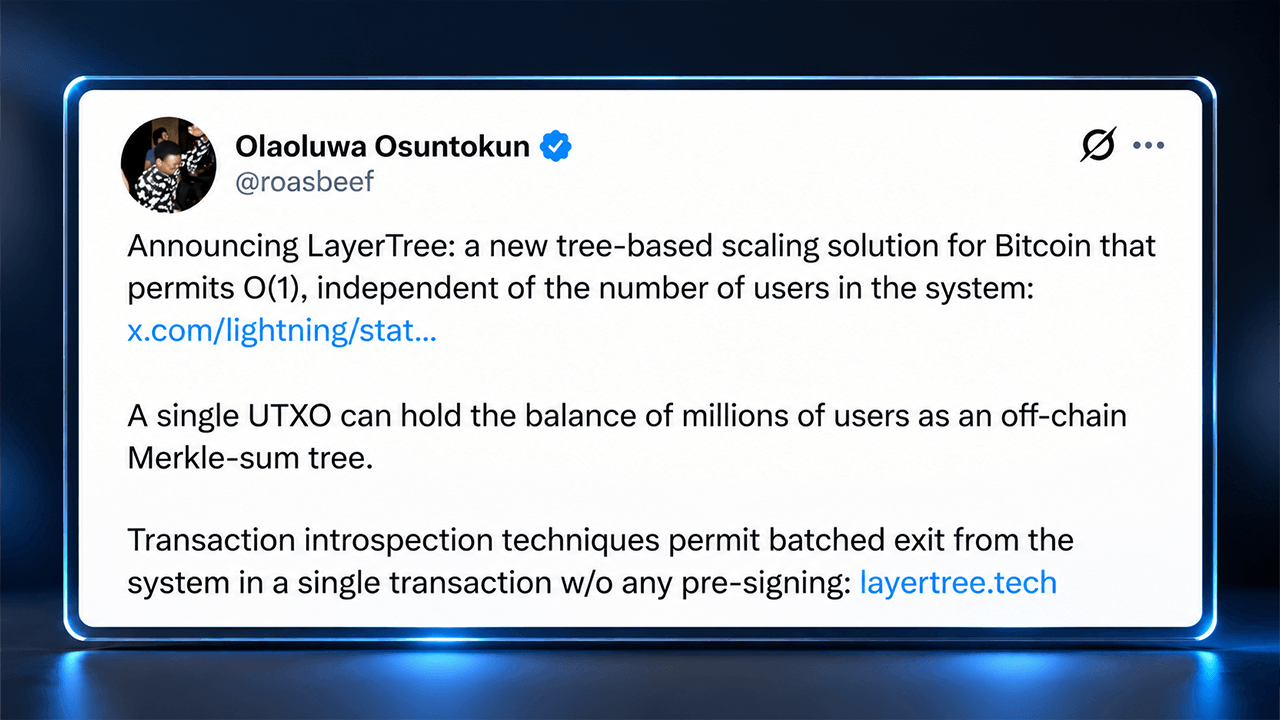
On Oct. 15, 2026, Lightning Labs developer Olaoluwa Osuntokun published a 103-page paper introducing Layertree, an ambitious attempt to make Bitcoin more affordable for large groups of users without handing custody of their funds to someone else.
Today, Bitcoin records individual holdings through separate pieces of digital money called unspent transaction outputs (UTXOs). Each takes up space on the blockchain, and moving that money requires paying transaction fees. Layertree flips that arrangement on its head. Instead of giving everyone a separate output, thousands or potentially millions of people could share one, with individual balances tracked through a mathematical record maintained outside the blockchain.
Think of an apartment building. Everyone shares the same roof, but each resident has their own apartment. The building manager handles operations without owning everyone’s belongings. That’s essentially what Layertree proposes for Bitcoin. The system uses something called a Merkle-sum tree, which is a mathematical record that tracks everyone’s balance while allowing Bitcoin to verify ownership without storing every account individually.
Your Bitcoin, Your Exit, No Permission Required
Here’s where things get interesting. Although an operator manages the shared system and approves new members, that operator cannot simply seize someone’s bitcoin or prevent a valid withdrawal. Anyone who wants to leave can submit a mathematical proof showing how much bitcoin belongs to them. A special Bitcoin rule, known as a covenant, checks the proof, releases their funds and updates the remaining balances.
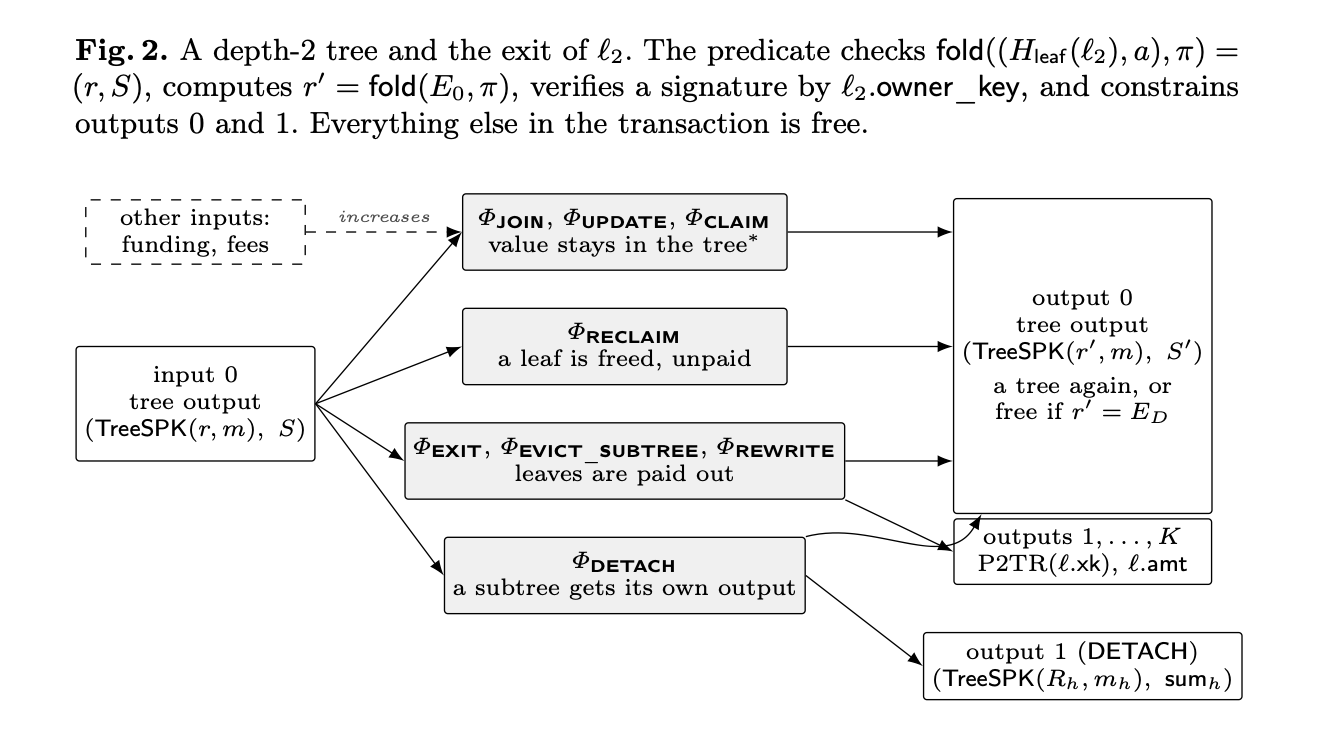
No operator approval is required to withdraw, and there’s no mandatory waiting period or expiration date for the shared output. Osuntokun’s paper also puts some numbers behind the idea. In a system with 65,536 available positions, withdrawing individually would require approximately 1,020 virtual bytes (vB), a measurement Bitcoin uses to calculate transaction fees.
That’s roughly nine times the size of a basic Bitcoin transaction, but considerably smaller than the approximately 2,511 vB needed for a comparable Ark-style withdrawal. The real savings emerge when people join together. Under the paper’s stated funding assumptions, enrolling around 1,000 members could cost less than 1 vB per person.
The Catch Behind Bitcoin’s Shared Wallet Experiment
Layertree isn’t without complications, and some are substantial. First, operators control admission. They cannot block a valid withdrawal, but they can refuse to let someone join. Second, everyone shares one Bitcoin output, meaning simultaneous withdrawals compete for the same limited transaction space. If thousands try to leave together, the system could face serious congestion.
There’s also a responsibility placed squarely on participants. Before depositing bitcoin, members must verify the mathematical records proving their balances. Failing to do so could leave their funds permanently inaccessible. Most importantly, Layertree cannot operate under Bitcoin’s current scripting rules. It requires proposed capabilities, including new instructions that haven’t been activated.
Osuntokun has developed reference software, tested scripts and mathematically verified portions of the design. Still, those accomplishments don’t establish that the complete system is secure in everyday use. Layertree offers an intriguing bargain for Bitcoin’s future. Millions of people could potentially share the cost of blockchain space while retaining control of their bitcoin. But the same shared output that makes the arrangement economical could become its biggest headache when everyone heads for the exit.