
Key Takeaways
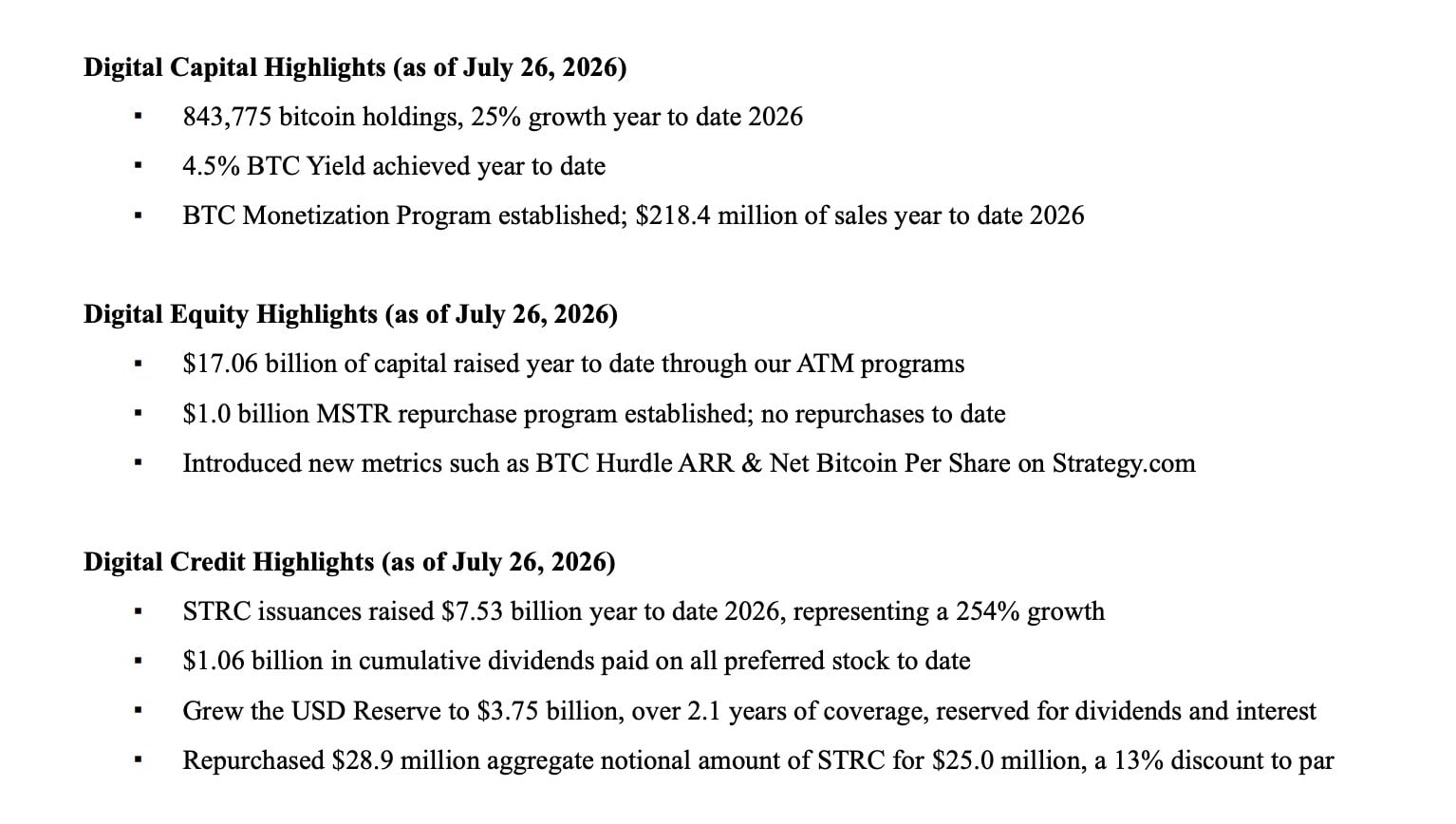
- Strategy now holds 843,775 BTC, up 11% at the end of Q2, per its latest earnings report.
- The firm sold 3,588 BTC for $216 million in early July, extending its break from “never sell.”
- Strategy’s USD reserve hit $3.75 billion after a $544.5 million raise, covering 2.1 years of dividends.
Holdings Grow Even as Sales Continue
Strategy disclosed the results in its second-quarter 2026 financial report, published July 30. The company grew its bitcoin stack 11% to 846,000 BTC by the June 30 quarter-end, funded largely through equity and digital credit offerings, then trimmed that total to 843,775 BTC by July 26 after a subsequent sale.
The firm’s bitcoin per share (BPS) metric, which chairman and co-founder Michael Saylor uses to argue Strategy still compounds value for holders even while selling bitcoin, rose 5% quarter over quarter to 210,824 satoshis. Net debt fell 18%, from $8.2 billion to $6.7 billion, a reduction executives credited to the growth of the company’s digital credit business rather than bitcoin sales alone.
Strategy nonetheless posted an $8.22 billion quarterly net loss, driven by unrealized markdowns on its bitcoin position after BTC’s price pulled back sharply from its 2026 highs. The paper loss does not affect the company’s underlying bitcoin count, but it has weighed on MSTR shares, which have traded well off their highs for the year.
The ‘Never Sell’ Doctrine Collapses
The Q2 filing confirms a shift that began in May, when Strategy sold 32 BTC at a loss, its first standalone net bitcoin reduction since 2022. The move ended four years of a public “never sell” pledge Saylor had repeated at nearly every earnings call.
That shift accelerated in early July, when Strategy sold 3,588 BTC for roughly $216 million at an average price near $60,000, realizing a $203 million loss, to help fund distributions on its STRC perpetual preferred stock. The sale marked the company’s largest single bitcoin disposal since it began accumulating BTC in 2020.
Saylor noted that the sales were not a retreat from Strategy’s bitcoin treasury strategy but routine capital management. When asked on the earnings call and whether the company would instead lean on options or other volatility-based tools to fund its obligations, he said:
There’s only one company in the world that can sell credit at our scale.
Saylor argued that selling volatility products would introduce counterparty risk, add complexity to Strategy’s capital structure and create tax complications the firm wants to avoid, leaving bitcoin sales and digital credit issuance as its preferred levers instead.
Digital Credit Fills the Gap
Strategy’s digital credit vehicle, STRC, has become central to that approach with its notional value growing from $2.8 billion at the end of 2025 to $10.5 billion by the close of the second quarter. As a result, institutional holders now account for 29% of outstanding STRC, up from 22% a quarter earlier.
The company raised $8.4 billion in total capital during the quarter, including $5.5 billion through digital credit instruments, bringing its year-to-date capital raised to $17 billion (44% of it through digital credit rather than traditional equity sales).
Strategy’s USD reserve, the cash buffer it uses to cover preferred dividends and interest payments, grew 12% during the quarter to $2.4 billion, then jumped further to $3.75 billion after a $544.5 million share sale between July 20 and July 26. That reserve now covers roughly 2.1 years of obligations, within the company’s target range of two to three years and well above its 12-month minimum threshold.
With 843,775 BTC on its books after its latest disposal, Strategy remains the largest institutional holder of bitcoin globally.
